


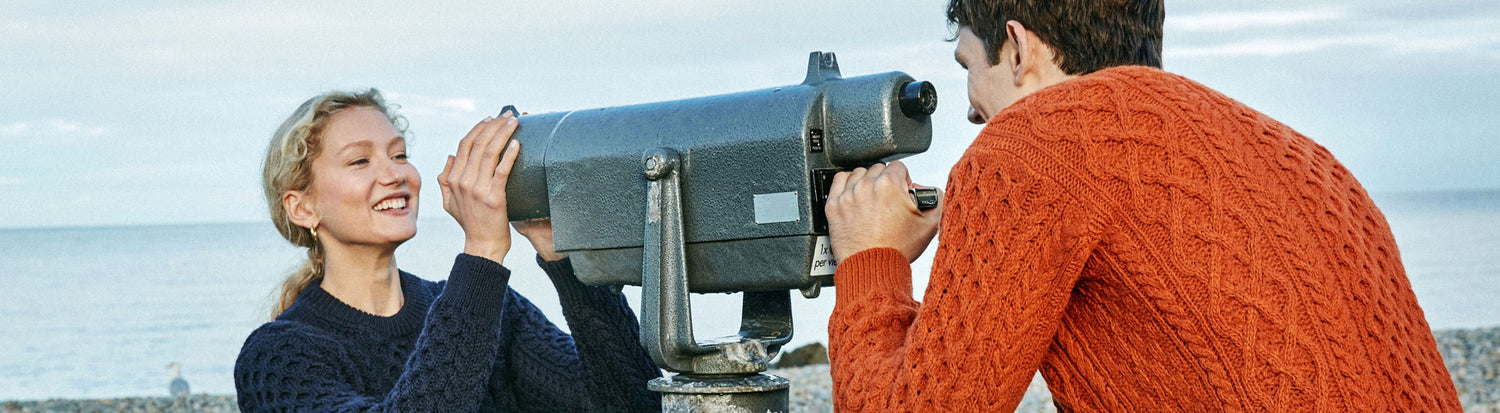
The History and Heritage of the Aran Sweater
The three Aran Islands sit at the mouth of Galway Bay, overlooking the wild Atlantic Ocean. The biggest island, Inis Mór is home to the ancient fort of Dún Aonghasa, one of the oldest archaeological remains in Ireland. It is a fort perched on a sheer cliff edge above the sea. Historical remnants of Ireland are visible on the islands; beehive huts, dry stone walls and thatched cottages still mark the landscape today. This is evidence of a community that has always had to build for shelter and warmth first.
-

Dún Aonghasa + Atlantic Ocean
Credit: Discover Ireland -

Honeycomb fields
Credit: Discover Ireland


The Stitches
The sweater that now carries the islands name grew out of this world. Traditionally made from undyed báinín - sheep’s wool - Aran designs often incorporate combinations of stitch patterns. These patterns are imbued with different symbolic meanings; cable stitches are said to represent fisherman’s ropes, and bestow good fortune on the wearer for safety on their journey out at sea, as well as good luck for a bountiful catch. Honeycomb stitches pay homage to the hard work of honeybees and the sweet reward their efforts carry. The diamond stitch depicts the stone boundaries of the fields which farmers worked on the islands. Diamonds stand for wealth and hope for a bountiful harvest.
-

Diamond stitch
-

Cable stitch
-

Honeycomb stitch


The Islands
The islands developed a resourceful, self-sufficient community with their own rituals and customs, music and storytelling traditions. As the last stop of the British Empire, before America, it was one of the last places to be anglicised and introduced to the English language. On the islands today, Irish is still the primary language.

The development of the Aran industry
The sweater’s commercial success began with the establishment of the Congested Districts Board, set up by the British government in 1891 to develop the west of Ireland, which encouraged knitting on the islands as a way for households to earn extra income alongside fishing. In the 1930s, Muriel Gahan, a rural Ireland campaigner for traditional crafts, visited the islands and is credited by historians with commissioning the first Aran sweater in its modern form. By 1935 they were on sale in her Country Shop on St Stephen's Green in Dublin, where knitters were named, valued and paid fairly. Electricity didn't reach the islands until 1973, so for decades the women worked by paraffin lamp after dark.

Aran goes global
Vogue featured the sweater in 1956, and demand grew quickly in the United States. Around this time, an Irish journalist who had recently acquired Galway Bay Products Ltd. named Pádraig Ó Síocháin began to develop, market and export hand-knitted Aran Islands's knitwear through his company. He worked with the islanders to develop written patterns and standard sizings, replacing the oral tradition that had passed knitting on before. In March 1961, the Clancy Brothers, an influential Irish folk band who are credited with bringing Irish traditional music to the USA, wore matching Arans on the Ed Sullivan Show, reaching tens of millions of viewers. Hollywood followed with Steve McQueen, Grace Kelly and Marilyn Monroe all wearing aran or aran-inspired .

The Rise of Knitting Machines
By this point, demand had outgrown what hand-knitters could supply, and the industry's response was mechanisation. Domestic and semi-industrial knitting machines, developed through the 1960s and 70s, made it possible to reproduce Aran cables and textures far faster than by hand, without losing the look that made the garment famous.

IrelandsEye Knitwear Est. 1988
IrelandsEye Knitwear emerged out of this movement. We started with six family members in 1988, and our business has now involved three generations of the same family. Today we employ a team of 50 people in our factory in Dublin, as part of our extended family, and we continue to produce high-quality knitwear that we ship to customers all over the world. Like the islanders before us, we're inspired by nature and by the colours and textures of the Irish landscape. Every design starts life as a sketch in our designer's notebook, before it becomes a piece of knitwear built to last.
Aran Sweater FAQs
What is an Aran sweater?
An Aran sweater is a textured knitted garment traditionally associated with the Aran Islands at the mouth of Galway Bay. Classic Aran designs combine cable, honeycomb, diamond and moss stitches, creating distinctive patterns inspired by island life, farming, fishing and the surrounding Atlantic landscape.
What were traditional Aran sweaters made from?
Traditional Aran sweaters were knitted using undyed báinín, a natural sheep’s wool. Its warmth and practical qualities made it well suited to life on the Aran Islands, where islanders lived and worked in exposed coastal conditions.
What do the stitches on an Aran sweater mean?
Aran stitch patterns are associated with different elements of island life. Cable stitches are said to represent fishermen’s ropes and hopes for safety at sea. Honeycomb stitches reflect the work of honeybees, while diamond stitches recall the stone-walled fields farmed by island communities.
Why are Aran sweaters associated with Irish heritage?
Aran sweaters reflect the landscape, livelihoods and storytelling traditions of Ireland’s Atlantic islands. Their textured stitches draw on fishing, farming and nature, making them an enduring part of Irish heritage clothing and knitwear design.
When did Aran sweaters become popular?
The commercial development of Aran knitwear began in the late nineteenth and early twentieth centuries. Aran sweaters became more widely available during the 1930s and gained international recognition after appearing in Vogue in 1956 and on the Clancy Brothers during their 1961 appearance on The Ed Sullivan Show.


